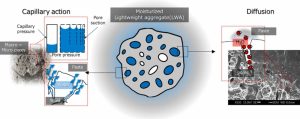
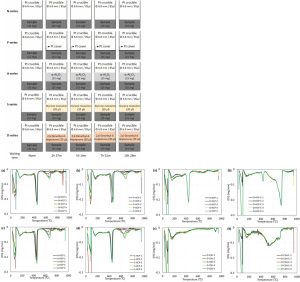
In recent years, research has emerged that uses multispectral imaging and hyperspectral imaging to evaluate the distribution of components and moisture distribution in concrete. Most of these researches have been limited to analyses with specific test conditions and sample compositions..
Our group(the Laboratory of Building Materials, Faculty of Engineering, Hokkaido University), received a research grant from the NEDO Green Innovation Fund for “Technology Development for Quality Control and CO₂ Fixation Evaluation Methods for Concrete that Maximizes CO₂ Emission Reduction and Fixation / Standardization of CO₂ Fixation Amount Evaluation in Concrete” from the NEDO Green Innovation Fund. This method enables the evaluation of carbonation depth equivalent to that of phenolphthalein without contaminating the core sample, using cross-sections of inspection holes in existing concrete or core test specimens, regardless of the concrete mix design or surface moisture conditions.
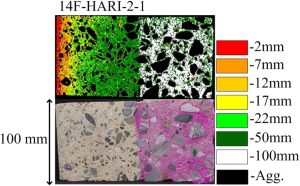
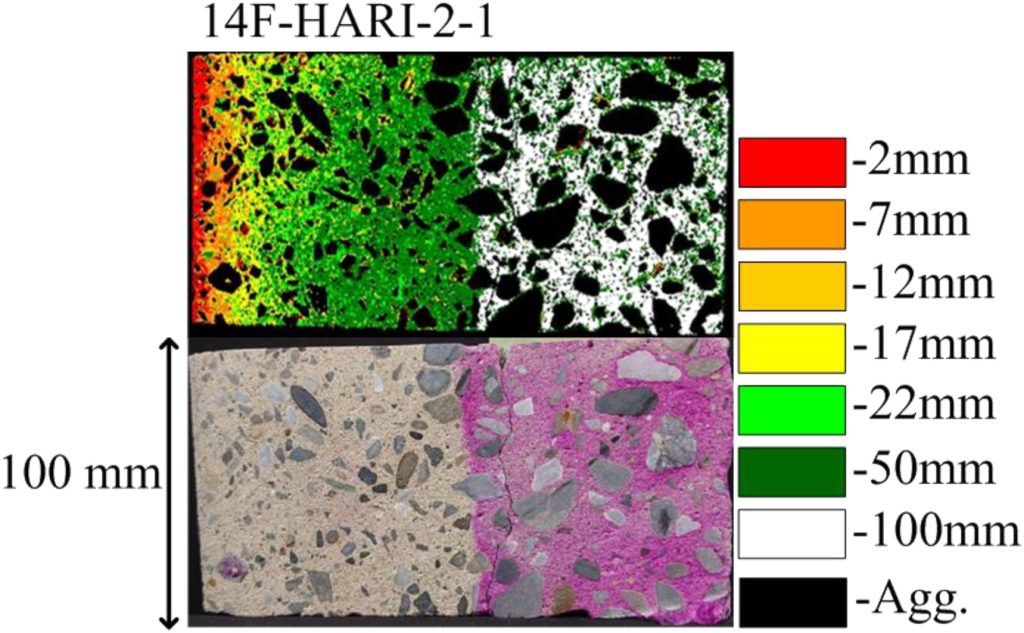
The figure below shows some of the survey results published in this paper. For concrete cores without mix info, the evaluation results equivalent to those obtained with phenolphthalein-spraying can be obtained. Similar results have been obtained for concrete with also unknown mix design not only in this test specimens but also in other surveys using this method.
Furthermore, for this hyperspectral (multispectral) imaging, we used a camera covering a wide range of 960–2500 nm, distributed in Japan by KLV Co., Ltd., rather than a camera covering the widely used 400 nm–1700 nm range. It has been clarified that the 1900–2500 nm range, which is particularly relevant to concrete, plays an extremely important role for Ca-based minerals, mainly calcium hydroxide. and calcium hydroxide.

This method can also be used on site. In the paper, an elliptical mirror with a cross-section cut at a 45°angle is inserted into the monitoring core hole, and by simply taking multispectral images of the concrete inner wall reflected in this mirror, the degree of carbonation in the depth direction can be obtained in the same way as in the laboratory. Of course, it is rougher than laboratory observation, but the color depth with phenolphthalein can be clearly understood. Furthermore, although not mentioned in the paper, our group has also conducted this survey at actual construction sites, bringing multispectral cameras and portable halogen lights into dark areas to verify its practicality. Each location takes about 5 to 10 minutes to photograph, including setting up the camera and lighting, and we have found that continuous operation is possible in practice. (Furthermore, since this hyperspectral camera can be mounted on a drone, unlike the phenolphthalein method that requires spraying, it is technically possible to perform self-propelled photography using a drone.
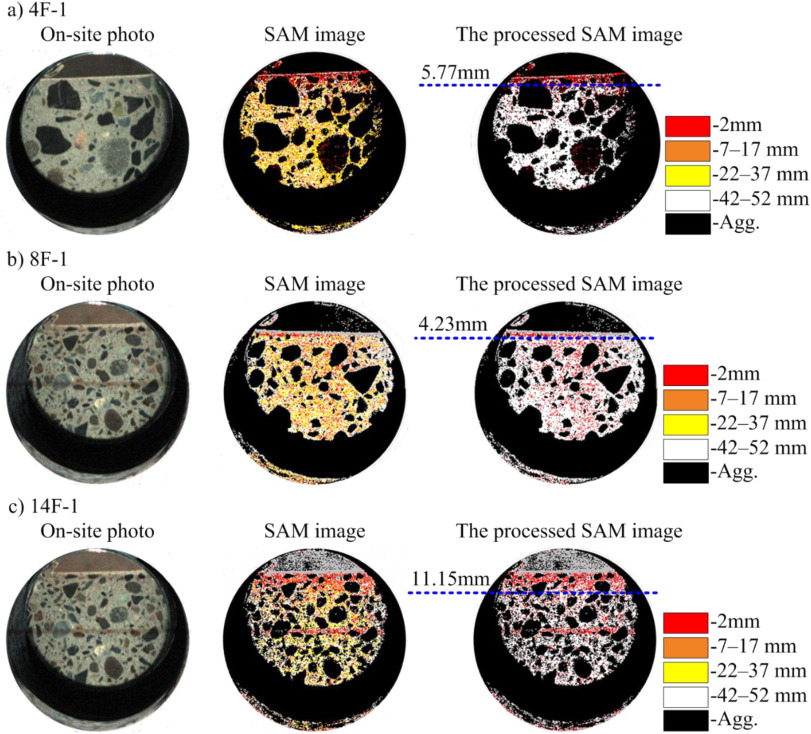
Please see the paper as the following URL
https://www.sciencedirect.com/science/article/pii/S0958946526000387