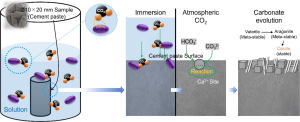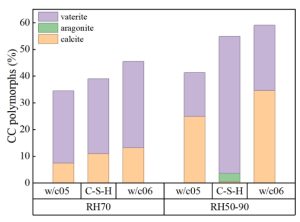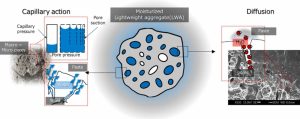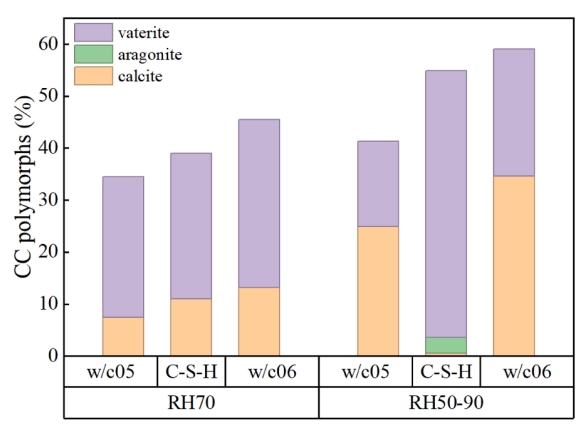
This paper presents a study investigating the carbonation mechanism and reaction kinetics of calcium silicate hydrate (C-S-H)—a major hydration product in concrete—under wet-dry cycling conditions. In the experiments, synthesized C-S-H paste was subjected to carbonation under various relative humidity (RH) conditions. The results showed that the carbonation rate of C-S-H in a wet-dry cycling environment ranging from 50% to 90% RH was 1.67 times higher after 14 days compared to that under a constant humidity of 70% RH. This accelerated carbonation is attributed to a cycle in which CO₂ penetrates the voids during the drying phase; during the subsequent wetting phase, the dissolution of CO₂ and C-S-H is promoted, leading to an increase in ion concentration; and during the next drying phase, calcium carbonate precipitates (enhanced CO₂ dissolution and Ca²⁺ migration). Furthermore, repeated wetting and drying widens the microscopic cracks caused by carbonation and drying shrinkage, further facilitating CO₂ diffusion. Furthermore, unlike ordinary cement paste, the carbonation of C-S-H yields a quasi-stable phase of calcium carbonate called “batelite” as the main product (over 90%), and simulations have shown that this is thermodynamically stabilized by low pH, the pore entrapment effect, and the presence of trace amounts of Mg.
Furthermore, a hallmark of our group’s research is that, with practical costs in mind, we often adopt a research approach that promotes CO₂ fixation using atmospheric CO₂ and coarse-grained fractions during carbonation. Like our other studies, this research was conducted using granular samples ranging from 0.6 to 1.18 mm in size and atmospheric CO₂, and—along with our research on the atmospheric carbonation of other coarse aggregates—it forms part of a series of technologies related to waste concrete, for which resource recovery and enhanced CO₂ sequestration are sought. We intend to continue developing this technology as a promising method for significantly improving the CO₂ absorption efficiency of waste concrete and promoting its effective utilization in the sustainable construction sector.