In the field of concrete engineering, there is a history of technological development driven by the idea that “ships could be built out of concrete.” For example, during World War I and II, when steel was in short supply, concrete tankers and supply ships were built and actually utilized into service all over the world. Furthermore, these vessels were not only used for their primary purpose but were also reused—that is, repurposed—after their initial service stopped. For instance, a concrete coal carrier operated in France during World War I was repurposed as a “refugee shelter” after the war. It is said that the Salvation Army (a private aid organization for refugees in France) commissioned the world-renowned architect Le Corbusier, and the ship was renovated by Kunio Maekawa and put into service, who was working at Le Corbusier’s office at the time. Furthermore, in Japan, concrete ships used as transport vessels during World War II were sunk along the coast at the end of the war and are still used as seawalls today. (The story behind this has been adapted into a manga series titled “Concrete Ship,” which is currently serialized in Big Comic Original as of April 2026.) As such, the history of concrete ship technology is just as long-standing as that of reinforced concrete, and these structures still exist today. (For those interested, the Wikipedia articles on concrete ships are extremely detailed, so please refer to them: (Japanese) (English))
From a performance perspective, concrete ships tend to be heavier than those made of steel or FRP, which appears to be a drawback that leads to poorer fuel efficiency. Technical reviews regarding the performance of concrete ships have been published both domestically and internationally for many years, and this issue is frequently highlighted. Consequently, various solutions have been proposed to address this challenge, including weight reduction, thinner walls, cross-sectional design, and construction methods. Even today, “floating concrete structures”—a broad category that includes concrete ships—such as “megafloats” and “floating wind turbines” are in operation and practical use, and these insights may be put into good use.
Furthermore, from an educational perspective, the “Concrete Canoe Championships” (Japan) (USA), where people board and race by paddling, are actively held by the American Society of Civil Engineers and the Japan Society of Civil Engineers. Looking at photos and videos of the Concrete Canoe Championships, it looks like a lot of fun. If there were a world championship, I’d love to see a canoe packed to the brim with ripped musclemen win it all and flex their pecs on the podium. But actually, wouldn’t it be educationally interesting to have a “concrete boat competition” that’s a bit more intellectual—where technology and ingenuity fusion?
So, We started thinking: what if we used mini “motor” boats made of mortar(concrete), called Mini Mortar Motor Boats (MMMB) tuned them like Mini 4WD cars, and held a “boat race”?
When building a boat made of mortar, the key is balancing buoyancy and load. In normal concrete structures, buoyancy is rarely a factor since they’re not designed to float. Also, naturally, a shape that minimizes water resistance and maximizes propulsion is desirable. Not that I know much about boats, though.
We’ve gone on and on with all this talk, but since the idea popped into my head, I might as well just go ahead and do it.
The image below shows how I used clear plastic folders to create two boat-shaped molds with slightly different shapes, casted mortar into the gap between them, and removed the molds after one day.
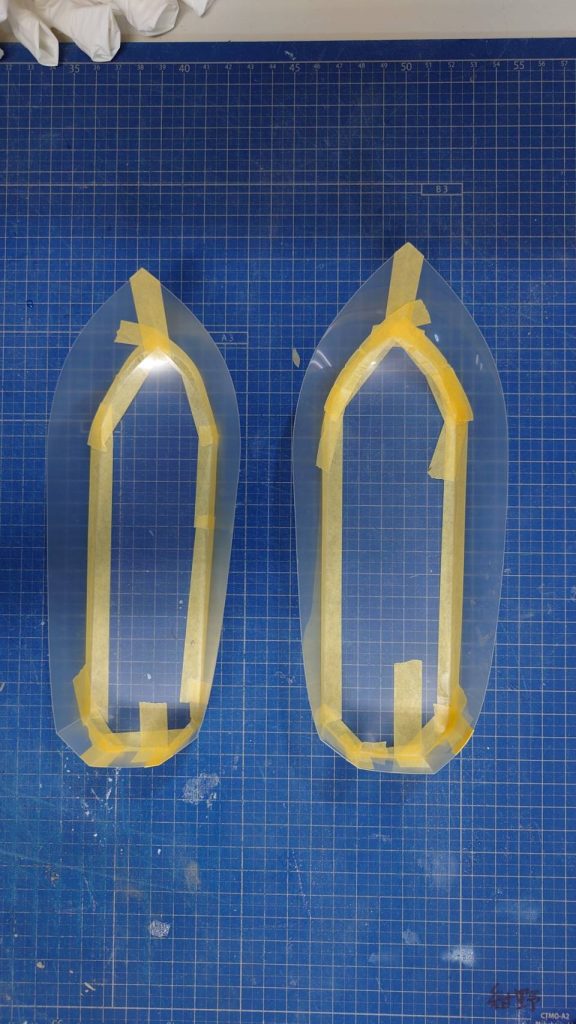
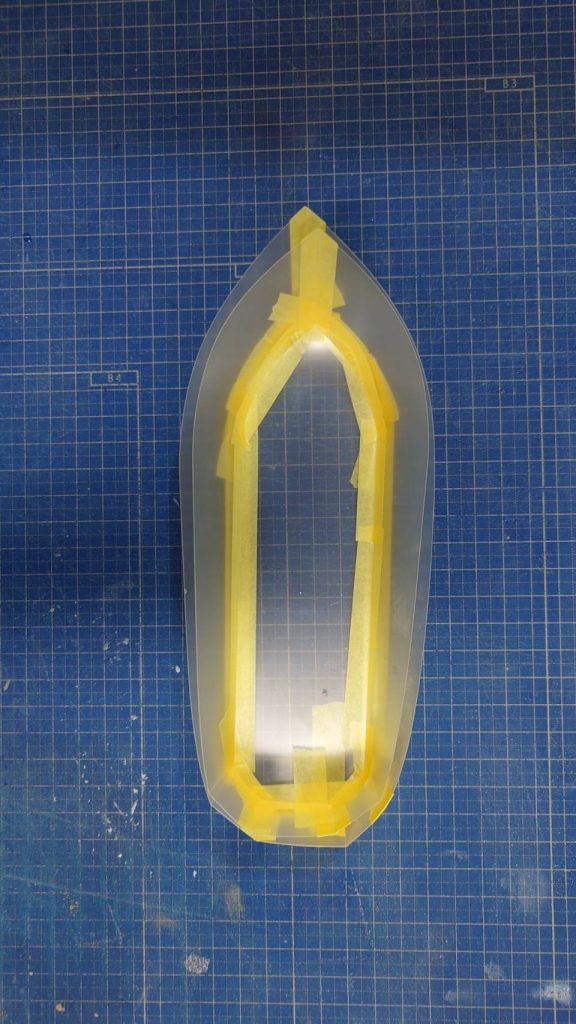
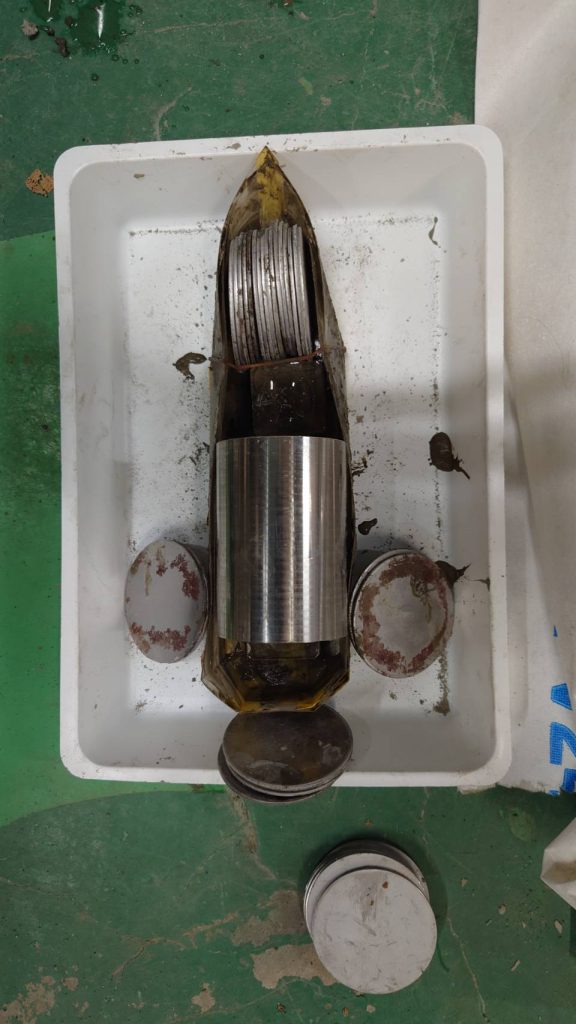
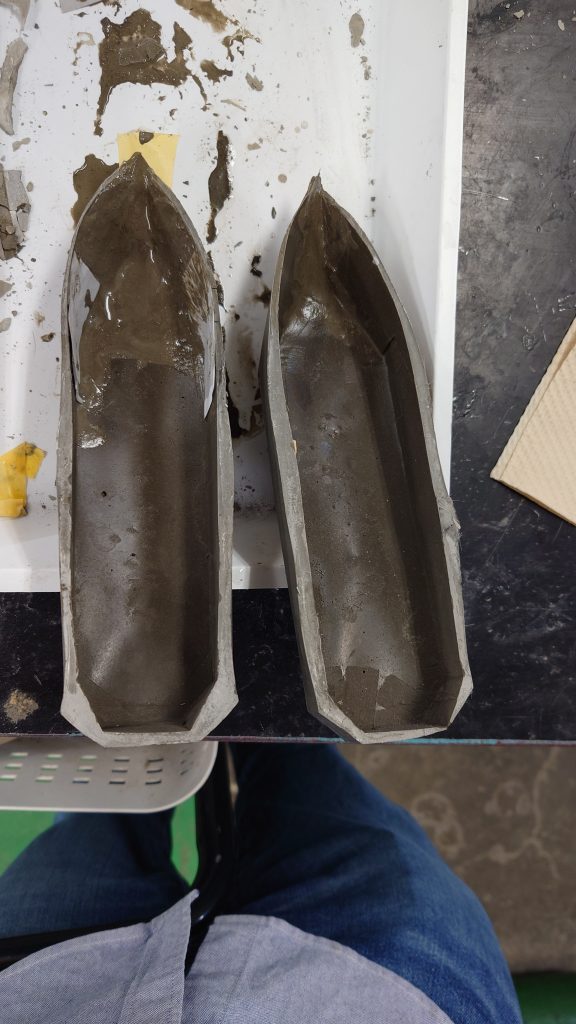
After carefully demolding the piece and allowing it to cure underwater for several days, the result is shown below. I might need to refine the formwork and casting methods further. Since I was working on a whim, I hadn’t considered how to reinforce the flimsy plastic folder formwork. For example, I could try burying the formwork in sand before casting the concrete, or perhaps devise a different method inspired by shipbuilding dry docks.
Now that we have a motorboat, all that’s left is the course. Because we can’t exactly float it in a pond, we might as well build this made of concrete too. As shown in the movie below, we connected concrete U-channels and lined them with trash bags and blue tarps to create a pool. It turned out pretty well, actually. Well, we guess that makes sense. (The boat we are running for testing is a plastic toy boat in this movie.)
Finally, I attached a motor to the mortar boat I’d built and tested it out in a bucket. ↓
(I attached a Tamiya’s underwater motor using a suction cup. It sticks really well even when the boat is wet. I’m definitely going with this.)
We tried a race on bath tab. Simular speed with a plastic boat above.