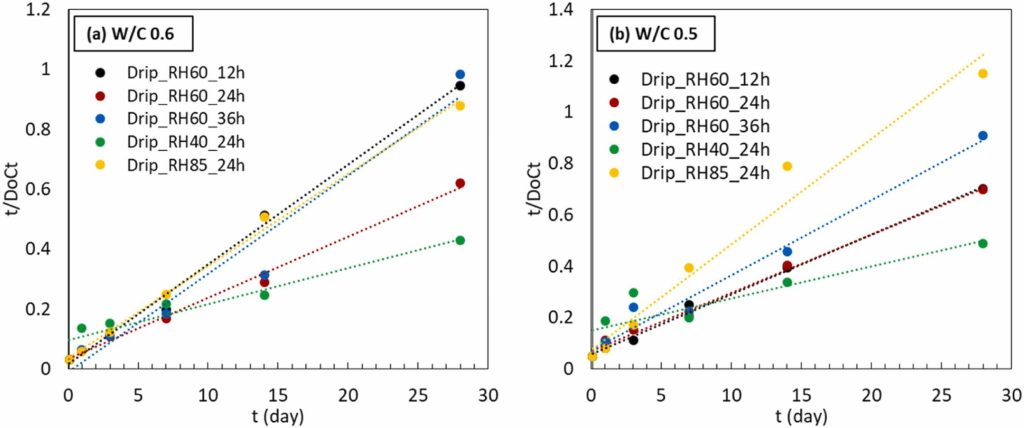
When concrete or cement paste undergoes carbonation, the process progresses at the surface, causing it to become denser, which makes it difficult for gas to penetrate inward and for moisture to escape. As a result, it is difficult to achieve carbonation deep within the concrete, and this poses a major challenge in promoting CO₂ sequestration in hardened concrete. (In some cases, methods such as DAC coating can be used to deliver CO₂ deep into the concrete, but that is a separate topic.)
In the approach presented by Professor Oh in this paper, the “dripping method” (a method that controls the cycle of wetting and drying by periodically dripping water) proposed by our laboratory is employed. This study reports on a method for identifying the optimal conditions for utilizing the dripping method to address the difficulty of carbonating Ca ions deep within the material under atmospheric CO₂ concentrations.
First, the sample sizes range from 0.6 mm to 1.18 mm, utilizing the recycled fine aggregate that can be produced at a typical recycled crushed aggreate specifically, we are focusing on slightly coarser particles within the “practical” fine fraction. This is because, in our research, we aim to identify a particle size that allows for a production rate of at least 1 ton per hour—at least in typical recycled crushed stone plants—using only existing crushing equipment and screens, without requiring additional capital investment.
In the case of samples of this particle size, since they are coarser than the typical cement-hardened powder commonly used in carbonation studies, there is a challenge: if carbonation is conducted, only the particle surfaces carbonate, while the carbonation of the internal Ca ions tends to lag significantly.
In other words, our focus is on finding an answer to the question: What environmental conditions are optimal for promoting CO₂ fixation—using only atmospheric CO₂ concentration and by controlling the watering interval—when targeting cement hydration particles that are slightly coarse but practical to produce?
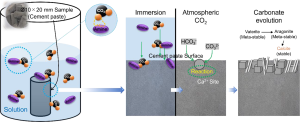
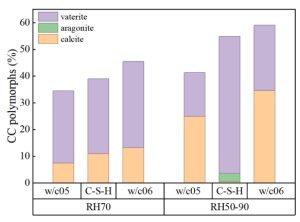
To summarize, under a 40% RH atmospheric CO₂ environment, the DoC exceeds 60% over 28 days with the dripping method in irrigation at 24-hour intervals. We have clarified the mechanism by which, when drip irrigation is performed in a dry environment of 40% RH, strong capillary tension (wicking effect) resulting from evaporation causes Ca²⁺ ions inside the particles to be drawn to the surface and precipitate, while microcracks form, maintaining the internal porosity. Furthermore, the experimental results indicate that, even without submerging the particles in water, this method allows the amount of CO₂ fixed to be calculated simply in proportion to the elapsed time. I believe these results represent quite good performance for a reaction system that is not composed of extremely fine particles and does not require complete carbonation underwater—a system that can be implemented at a low practical cost.
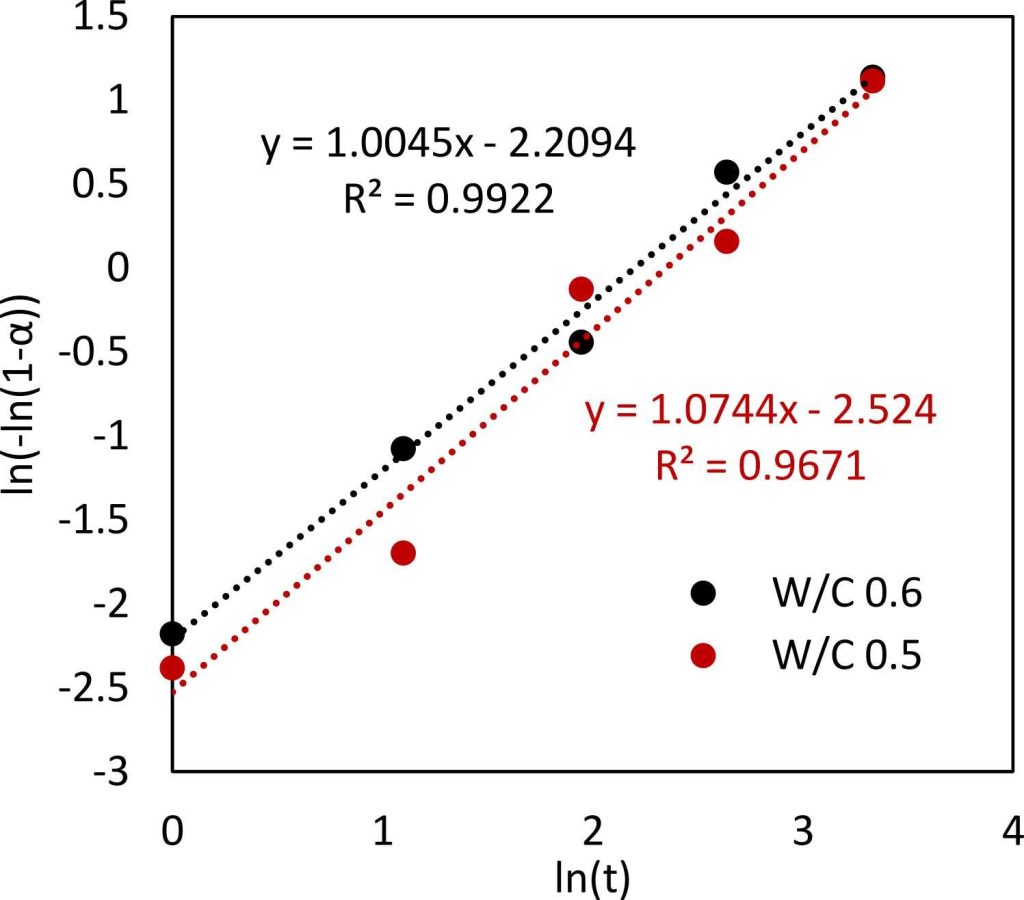
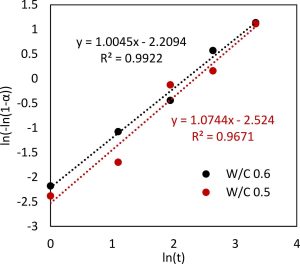
Furthermore, since these results are based only on W/C ratios of 0.5 and 0.6, I believe the results would change if the water-to-cement ratio were lower; however, it is interesting to note that within this range, the rate of carbonation is nearly the same when using our optimal drip conditions. In short, this is because the Ca ions are first drawn to the surface before carbonation occurs; therefore, the carbonation rate after they are drawn to the surface is nearly the same. In other words, it helps to understand this as meaning that the carbonation reaction occurs in a region where the diffusion of carbonate ions is not a factor.
Even with larger particle sizes, since Ca ions deep within the material are first brought to the surface before CO₂ can be fixed, a transition from CO₂ diffusion-limited to interfacial reaction-limited kinetics (sustained linear reaction) is achieved. I think this is a rather interesting analysis, as it mathematically and kinetically (using the JMAK model) demonstrates how the wicking effect and microcrack formation overcome the conventional phenomenon where “calcium carbonate clogs the pores and the reaction plateaus,” thereby creating conditions where the reaction rate does not decrease and continues to progress linearly. If you’re interested, please be sure to take a look.